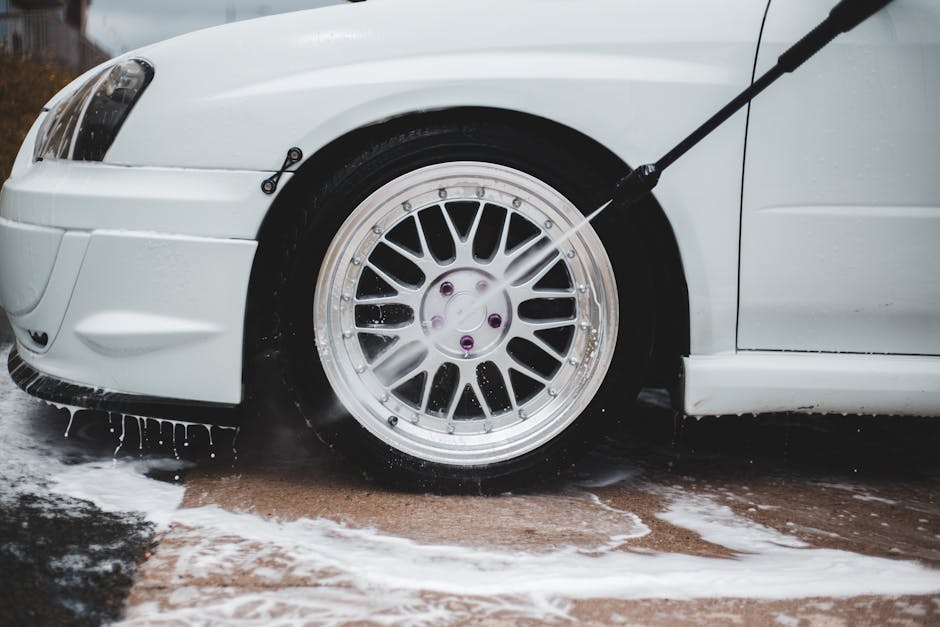
Photo: Erik Mclean / Pexels
Fall is the hardest season on hard surfaces. Wet leaves sit on concrete for a week and leave tannin stains that look like coffee spills. Algae and moss bloom on the shady side of a patio once temperatures drop into the 50s. Add pollen residue, grill grease and the black spot mildew that shows up under tree cover, and by November most driveways look a full shade darker than they did in July. A pressure washer is the fastest fix — but which one you buy depends far more on your driveway size and storage situation than on the PSI number printed on the box.
This comparison puts four genuinely different machines side by side: the Giraffe Tools Grandfalls wall-mounted electric system, the budget-favorite Sun Joe SPX3000, the Ryobi RY142300 brushless electric, and the Simpson MegaShot MS60763 gas unit. They range from roughly $160 to $600, and each one is genuinely the right answer for someone — and genuinely the wrong answer for someone else.
When evaluating Best Pressure Washers for Fall Driveway and Patio Cleanup in 2026: Top Picks Compared, the key factors to consider are build quality, long-term durability, and whether it genuinely solves the problem it claims to address.
We looked at real cleaning throughput (GPM matters more than PSI for driveways), hose length and setup friction, cold-weather storage, noise, and what actually breaks after two or three seasons. No default winner here.
Average order value: $150+
Shop Giraffe Tools — See PricesThe Grandfalls is the odd one out in this group because it isn't a cart — it's a wall-mounted unit with a retractable hose reel that you bolt to your garage wall and plug into a standard 120V outlet. Depending on configuration you get roughly 1800–2300 PSI at about 1.8–2.0 GPM, with a 100-foot retractable hose that covers most two-car driveways plus a patio without moving the machine. Prices generally land in the $400–$600 range depending on model and hose length, which is real money next to a $160 Sun Joe.
What you're paying for is the elimination of setup. The single biggest reason pressure washers sit unused is the 12-minute ritual of dragging a cart out, uncoiling hose, hooking up the garden line and then reversing it all. With the Grandfalls, you pull the hose, connect the water line once (it stays connected), and go. For fall cleanup — where you often want a 10-minute spot pass on leaf stains rather than a full Saturday session — that changes how often the thing actually gets used. Build quality is solid: metal fittings, a decent induction-style motor, and an adjustable pressure dial on the unit itself. The trade-off is that it's fixed to one location. It will not go with you to clean a boat at the ramp or help a friend's driveway across town.
Check current Giraffe Tools pricing and models →
The SPX3000 has been the default entry-level electric washer for close to a decade, and at roughly $150–$180 it remains hard to argue with. It's rated 2030 PSI and 1.76 GPM, includes five quick-connect nozzle tips, and has dual onboard detergent tanks — genuinely useful for fall, where you'll want a dedicated mildew/algae cleaner for shaded patio pavers. For a small townhouse driveway or a 300-square-foot patio, it does the job.
The honest downsides: the 20-foot high-pressure hose and 35-foot power cord mean you'll be repositioning the unit constantly on anything larger than a single-car pad, and the hose is stiff PVC that kinks in cold weather. The plastic wand and inlet fittings are the usual failure points — many owners replace the inlet connector within two seasons. It's a universal motor rather than induction, so it's louder and rated for shorter continuous run times. Buy it if your total hard surface is small or you use a washer three times a year.
Ryobi's 2300 PSI brushless electric, typically $350–$400 at Home Depot, sits between the Sun Joe and the gas units. The brushless induction motor is noticeably quieter and longer-lived than the Sun Joe's, it delivers about 1.2 GPM, and the upright cart design with onboard hose reel and 25-foot hose is the best-executed portable layout in this group. The turbo nozzle it ships with strips concrete stains faster than a standard 15-degree tip.
Where it loses to the Grandfalls is flow rate and reach — 1.2 GPM is meaningfully slower than 1.8–2.0 GPM when you're covering 800 square feet of driveway, and you'll still be dragging the cart and coiling hose every time. Where it beats the Grandfalls is portability and the fact that you can store it in a corner instead of drilling into your garage wall. Renters should look here first.
If your driveway is long, gravel-adjacent, or hasn't been cleaned in five years, gas still wins on raw throughput. The Simpson MegaShot with a Honda GC190 engine runs about $400–$450 and delivers 3200 PSI at 2.4 GPM. That GPM figure is the important one: it's roughly 25% more water per minute than the Grandfalls and double the Ryobi, which translates directly into square feet cleaned per hour. Surface cleaner attachments work far better behind a gas unit.
The costs are real, though. It's loud enough to annoy neighbors, requires oil changes, needs pump saver or full winterization before the first hard freeze, and 3200 PSI will absolutely etch soft concrete, damage mortar joints and shred wood decking if you use the wrong tip. For a typical suburban patio and two-car driveway, it's more machine than the job needs.
For leaf tannin and algae, chemistry beats pressure — a sodium hypochlorite or oxygenated cleaner with a 5-minute dwell time does more than an extra 1000 PSI. That favors machines with usable detergent delivery: the Sun Joe's dual tanks and the Grandfalls' onboard soap system both work well. For coverage speed on big surfaces, GPM rules, which favors Simpson then Giraffe Tools. For cold weather, all electrics need the pump drained; the Grandfalls has an advantage here because it lives in a heated or semi-heated garage rather than an unheated shed.
There's no single winner here — pick by situation. If you own your home, have a garage wall to spare, and clean your driveway and patio more than twice a year, the Giraffe Tools Grandfalls is the one you'll actually use, and the 100-foot reel plus ~1.8–2.0 GPM makes fall cleanup a 30-minute job instead of a two-hour project. If you're renting, or your hard surfaces total under about 400 square feet, buy the Sun Joe SPX3000 at $160 and put the $400 you saved elsewhere — it will clean the same concrete, just slower and with more hose shuffling. If you want portable electric with better durability than the Sun Joe and don't mind the lower flow rate, the Ryobi RY142300 is the smartest middle pick. And if you've got a 60-foot driveway, gravel edges or a decade of accumulated stains, the Simpson MegaShot MS60763's 2.4 GPM at 3200 PSI simply moves more dirt per hour than any electric in this comparison — accept the noise and maintenance as the price of that speed.
Average order value: $150+
Shop Giraffe Tools — See PricesFor routine fall cleanup — leaf tannin, algae, pollen and light mildew — 1800–2300 PSI with 1.8+ GPM is plenty, especially paired with a surface cleaner attachment and a dwell-time detergent. Gas units like the Simpson MegaShot (3200 PSI, 2.4 GPM) mainly buy you speed on very large areas and deeply embedded oil or rust stains, not fundamentally better results. On soft or older concrete, 3200 PSI can actually etch the surface if you hold the wand too close.
Disconnect the garden hose, run the unit for a few seconds to purge remaining water, squeeze the trigger to release pressure, then pump antifreeze-based pump saver into the inlet until it comes out the outlet. Any water left inside the pump will freeze, expand and crack the head. A wall-mounted unit in an attached garage is somewhat more forgiving than a cart stored in an unheated shed, but you should still run pump saver before the first hard freeze.
Yes for flat concrete and large pavers — a rotating surface cleaner gives you even results in a fraction of the time and eliminates the zebra-stripe wand marks that plague first-time users. Skip it on loose-jointed pavers, soft brick or anything with crumbling mortar, and match the attachment to your machine's GPM; a 2.4 GPM gas unit will spin a 15-inch cleaner properly, while a 1.2 GPM electric usually needs a 11–12 inch model to maintain rotation.
Found this helpful? Share it!
Our team tests gardening tools, planters, and outdoor equipment so you don't have to. Every recommendation is based on real research: customer reviews, expert opinions, and value for money. Learn more about us →
This post contains affiliate links. We may earn a commission if you purchase through our links at no extra cost to you.
← Back to Best Gardening Picks Daily| Retailer | Price Range | Shipping | Link |
|---|---|---|---|
| Amazon | Check Current Price | Free (Prime) | View on Amazon → |
| Walmart | Check Site | Free over $35 | Search → |
| Target | Check Site | Free over $35 | Search → |
Prices may vary. Click through to each retailer for current pricing.